Earlier this year, the hubby and I met a new
couple in town, Jamey and Hooma, along with their blue-eyed, Baby Betty Boop
look-a-like daughter, Zarapheena. (She's gorgeous!) Jamey, a clay
enthusiast, came across the hubby's pottery shop and popped in to talk
"mud". Come to find out, they were looking for a large piece of
property to develop an eco-friendly, off-the-grid, earthen house community,
complete with vegetable and fruit gardens, and solar energy. With so much
focus on eco-tourism in Costa Rica, it seems like a perfect fit.
Since the hubby is a potter, I'm always around clay and have seen it used to create lots of lovely things, however, I'd never thought about using mud or clay to
make something as large as a modern day living structure. Maybe this whole concept sounds as
intriguing to you as it did to me? Upon learning more about the process
and then seeing photos of the house they had built in Northern California, (and
especially after doing the following interview with Jamey), I was totally on board
with the idea and excited to witness firsthand this amazing project blossom into
fruition.
To give you an idea of what a mud/earth house
can look like, here are a few photos of the first house they completed.
Despite its dollhouse appearance, the house is about 420 square feet, has a
first floor living room and upper floor loft/bedroom area. Check out
Jamey’s FB album to see more photos.
 |
| Beautiful mosaic entry |
 |
| Bedroom/Loft. Beautiful stained glass windows! |
|
|
 |
| View from the loft into the living area |
How's that for playin' in the
mud!?!
Jamey and Hooma eventually found a great property about 10
minutes outside of Tamarindo and are now in the planning stages. The uniqueness of this project intrigues me, so I thought it might be interesting to follow
along and document it as it progresses.
Jamey was kind enough to let me interview him and gimme a peek at the history behind all this. The interview is a wee bit long,
but Jamey is a great interviewee (and writer since this was a written
interview!) and I promise that not only will you learn something about clay and the architectural process, but you'll be
entertained as well. Be sure to click on the links to the earth structure artists that
inspired Jamey so you can get a full appreciation for the scope of artistry
that can be accomplished using earth to build structures. Amazing!
Tricia: How and when did your "love affair" with clay begin?
Jamey: Though I enjoyed playing with Play Doh as a kid, I would say
that my “close friendship (with benefits)” with clay really blossomed after
discovering that it was the key to achieving my quest of integrating art with
architecture. As an art/design major with a focus on architecture in
college, I had a vision of combining the two and building sculptural homes—some
kind of a cross between caves and playgrounds, because I was sick of all the
conventional box-like forms people tended to litter the landscape with. Once
I proved to myself that it could be done in a perfectly functional way (despite
being told by the chairman of the architecture department in Denmark to forget
it because it’s virtually impossible), the biggest obstacle (other than
building codes) was economics. Such homes would normally cost a
fortune since constructing organically shaped, non-rectilinear houses with
rectilinear materials is normally a very tedious and expensive proposition, a
luxury typically affordable only by the wealthy.
However, when building with earth, curves are
just as functional as they are aesthetically pleasing, and clay has to be the
most fluid art and architectural medium in existence. Not only that,
but earth is the most abundant, inexpensive, ecological, and sustainable building
material, and houses built with it have the ability to be resistant to fire,
earthquakes, water, mold, rot, UV, acid rain, rodents, termites, and even
bullets, with excellent aerodynamic, thermal and acoustical insulation
properties as well. No wonder humans and animals have been building
with it for millennium! Clay also happens to be one of the best
medicines for cuts, burns, swelling, splinters, external and internal
detoxification, and can even remove heavy metals and radioactive particles from
our bodies. What more could one want from a material?
Tricia: Wow, I don't think most people think of mud as such a useful element. Was there something or someone that inspired your idea to use
clay for building structures?
Jamey: While still an undergrad, years before I had ever even
considered using clay for building structures, I actually used it to construct
my first few models of those livable sculptures I had fantasized about,
because of its inherent sculptural qualities. Shortly after
graduating, I decided to spend a semester studying construction at a local
community college where the depressing reality had kicked in that even if I
could afford a small parcel of land, it would cost another fortune for tools
and building materials and, after several years of faithfully following my
intuition and not straying from my path, I started feeling very defeated.
It was at this time—in 1991—after attending an
Organic Architecture Convention in California and visiting structures built by
my favorite organic architects, I stumbled upon a book written by the internationally
renowned architect and author, Nader Khalili, who rediscovered the ancient
technology of “ceramic architecture”—the art of building and vitrifying adobe
buildings. Once I found out that all I needed was some simple hand
tools and the four elements (earth, air, water, & fire), I was so blown
away knowing that this was not only the solution to manifesting my vision but
it was nothing less than an architectural revolution—the key that would enable
anyone to build their dream homes while liberating themselves from a lifelong
debt to banks. I was absolutely ecstatic and practically finished
reading the book before I even got home that day. You can imagine my
surprise when I discovered shortly afterwards that the author was teaching at a
nearby architectural school! To make a long story short, I became
his most enthusiastic student and apprentice within the week.
Tricia: Was your earthen house in California your first attempt at
building a usable structure?
Jamey: No. Thankfully, I already had some basic carpentry
and welding skills from my sculpture and design classes, but my first usable
structure was a two-story wooden deck for my parents’
backyard. Shortly afterwards, I worked on an award-winning
elementary and junior high school in Tijuana with my favorite living “organic
architect”—the world-famous artist/builder--James Hubbell.
 |
| Kids and parents working on the mosaic in the Tijuana school. |
|
 |
| Mosaic done by Jamey in Tijuana |
Next, I apprenticed with another builder, Joseph Diliberti (whose work has been featured on
TV, newspapers, and the cover of Clay Art magazine), to build and vitrify an
earthen hut. Later on, I built a couple of greenhouses, a few
“hornos” (mud ovens) including a huge dragon-shaped one with the kids at a
local charter school, and an earthen playground at another charter
school. It’s one thing to design something on paper but it’s a whole
other thing to have to build it. One of the big problems with many
conventional architectural programs, is that most architecture students never
actually build anything, and their training tends to encourage/breed expensive
and ugly rectilinear buildings that don’t breathe. Personally, I
think all humans should learn how to build themselves a “nest” (like every
other animal), instead of being dependent on money, bankers, and professional
builders.
 |
| One of Diliberti's ceramic houses being fired (from the inside out). |
Tricia: How long did it take to build your home out of mud?
Jamey: MUCH longer than it should have! It was done on a
very part-time basis over the course of several years, some of which I didn’t
work on it at all. I bought land northern California in the year
2000 and was living in a very remote location and (for the most part), had
little or no help. I was in a very weakened state of health having
just recovered from cancer (due to living in a conventionally-built
mold-infested house), with an undiagnosed but inactive thyroid (due to the
radiation treatments) making it hard to muster up the energy I
needed. Especially after having to do lots of physically demanding
work to develop my land and create gardens, while trying to earn a living. I’ve
also had to deal with injuries from a dirt bike accident and two herniated
disks in my back. On the bright side, the long process and isolation
made it possible for me to spend years researching, designing, and refining my
architectural techniques.
In the end, I don’t know exactly how many hours
it took to build my home, but I can tell you that about 650 hours were spent
just digging, mixing, and applying the mud, not including the sculptural
layer. Now that I’ve figured out how to do it, and have gotten
plenty of hands-on experience, I’m confident that, with the right tools and a
few good helpers, I could build an equivalent structure in a month or
two. Theoretically, it would take two or three days to build the
foundation and framework, one day to excavate and mix the mud, a week or two to
smear the mud on the frame, and a few days to apply a few coats of lime, but
each coat would need at least a week to dry between coats, during which time,
other details like plumbing, electricity, tiling/mosaics, etc., could be
completed.
 |
| Creating the frame |
 |
| Hooma packing clay/mud onto the frame. |
 |
| She's such a hard worker :) |
Tricia: Are there any limitations on the type or size of structures that
can be built using clay?
Jamey: First, I need to point out that clay is only one component of
the earth mixture. By itself, a clay structure will crack very badly
which is one reason why sand and/or fibers are equally important
components. As for the type of structures that can be built solely
with earth (other than walls), one is generally limited to building using forms
that work well with the laws of gravity--like arches, apses, vaults, domes,
cones, and pyramids. However, there are ways around that—like by
using some kind of metal armature as I did with my loft. One can build mud
structures with vertical or diagonal walls but not unreinforced horizontal
ones. That’s partially why many earth houses have wooden roofs, even
though the wood lacks almost all of the earth’s beneficial qualities.
As for the age-old question of whether size
matters, no, it’s really more of a matter of proportion. There’s no
real limitation on height so long as the thickness of the walls is in the
proper proportion to support all that extra weight. There are
11-story high skyscrapers in Yemen built with mud which pale in comparison to
the heights of various mud brick pyramids still surviving after many centuries. To
put it in perspective, the planet Earth is a giant round earthen
structure. The only theoretical limitation on the size of a
structure is that it would have to be smaller than the planet it’s built on
because otherwise there wouldn’t be enough materials nor room to give it an
adequate foundation.
Tricia: What were some of the biggest issues that you’ve had to work
around?
Jamey: Once I
got past the societal programming and philosophical issues, the functional and
technological issues, the economic issues, my personal health issues, and lack
of help issues, the final and most formidable obstacle (more so than actual
construction issues), were the legal issues. By that I mean
oppressive building codes tailored to force people to buy expensive,
heavily-taxed, and often toxic, unsustainable, non-biodegradable, corporately
manufactured building materials, and pay for the various building code
inspections at various phases of construction. Though it’s perfectly
legal to be homeless (which is NOT safe), God forbid you try to build yourself
a shelter for protection from the elements (what should be a natural
birthright, as it is with all other life forms), you quickly realize that there
is an invisible leash around your neck in the form of building codes, enforced
by people whose own houses are not nearly as safe nor ecologically responsible.
Though I was aware of this significant
impediment from the beginning, and spent countless hours stressing out about
it, I refused to let it interfere with my architectural pursuit because I had
faith that if I could figure out how to make it work, I would find a way to
actually do it somewhere, even if I had to move to another
country. My initial solution was to live remotely in the wilderness,
outside the scrutiny of corrupt government officials, in a region known for
it’s relatively permissive building codes. However, though I haven’t
had any trouble so far, I realize that no matter how far away one chooses to
live, it’s hard to escape the nosey tax-funded bureaucrats armed with
satellites to spy on us. Next they’ll be using drones to make sure
nobody escapes their rigid regulations and fails to pay them for their
“services”. The consequences of building a structure without their
blessings can range from being fined, to being forced to demolish the structure
you spent years building with your own hands, to even being arrested and thrown
in jail. How’s that for an obstacle? Who would have
thought that building a simple mud shelter would be such a difficult and risky
proposition?
The fact is that governments (and the bankers that control
them) have made a fortune by instituting elaborate systems designed to deprive
people of their innate human right to house themselves under the guise of
public safety. As such, earth houses are a serious threat to their
financial well being which is why building a mud house is not just a more
artistic and ecological alternative to a conventional one, it’s an act of
revolution.
Tricia: Were there any surprises while building that you didn't
anticipate?
Jamey: Yes there
were a few big surprises—one was that it took so long. Part of the
problem was that I was not satisfied with the way the tractor-mounted
rototiller mixed the straw into the mud and, in the end, I decided to mix it
all by hand and foot instead, which took far longer than anticipated. Another
was the fact that I outgrew the house before I had a chance to grow into
it. I didn’t plan on getting married when I started the project, and
I certainly didn’t plan on having any kids but one popped out anyway.
Though my building is completely fireproof, a forest fire affected my building
process because (during peak building season), we had to evacuate for over a
month to escape the smoke as the firefighters struggled to contain the
fire. This was particularly bad timing for us because we desperately
needed to finish our mud house more than ever now that our baby girl was
born. I busted my ass struggling to finish before winter set in but,
by the time it finally came into fruition, we decided to move to Costa Rica.
Tricia: What made you choose Costa Rica to build your first community?
Jamey: I first
had the idea to move to this ecological paradise and build an intentional
eco-village over 20 years ago after unsuccessfully trying to convince a
prospective eco-village in upstate New York to build their community using a
modified version of Nader Khalili’s large-scale ceramic
technology. I later tried to convince all my friends and
acquaintances to chip in for a huge piece of land to build an earthen
co-housing community here in Costa Rica but there were no takers. People
liked the idea in theory, but either didn’t have any money to invest or were
unwilling to put their money where my mouth was. I ended up moving
to northern California instead but found myself becoming increasingly frustrated
with the government’s insanely destructive political, economic, and
environmental policies, and overall cultural trends in the U.S.
A few years ago, after visiting almost every
Central American country on our honeymoon (along with Mexico, Peru, and
Bolivia), with the intention of looking for a better potential place to
relocate, my wife and I agreed that Costa Rica was the best
alternative. Although there is no perfect place, Costa Rica seemed
like it was better suited for my project because of its peaceful, non-militaristic,
non-imperialistic, non-over regulated atmosphere, the government’s focus on
environmental protection, and the natural biodiversity. We were
interested in tapping into the thriving eco-tourism industry that attracts
environmentalists from all over the world who we thought would most appreciate
this eco-architectural technology. Now that we have a child, there
is the additional incentive to raise her amongst this friendly, baby-loving,
highly literate, and relatively safe society.
So, having overcome every obstacle life has
thrown at me so far, here I am finally getting ready to manifest this
practically lifelong utopian vision I’ve diligently worked towards for the last
26 years in the very country I tried to do it in over 20 years ago, but armed
with a lot more experience, knowledge, money, good Costa Rican friends, and an
intelligent and beautiful wife. I guess that’s another big surprise
I didn’t anticipate…
Tricia: 100 brownie points for that last portion, right ladies?? ;)
Tricia: Can you tell me a little about the eco-community you are
currently working on?
Ever since reading about fictional utopian
societies in high school, I’ve been aware of how much better our lives could be
with some intelligent architectural planning. In designing
structures and communities, architects and urban planners have incredible power
(though often misused due to their conventional training), to profoundly
influence human behavior both individually and on a societal level.
Most of us are wrapped up in the daily drama of
our lives and rarely give a conscious thought as to how much of our stress and
problems stem from the bad design of our homes, neighborhoods, and society as a
whole. Unfortunately, the civilization that we have inherited was
designed not for the interests of the community but by industrialists to create
perpetual consumers and, as such, is riddled with flaws that bring disease,
death, debt, and dysfunction upon its dwellers. Our ancient tribal
social structures have been dismantled and replaced with a capitalist version
modeled on factory warehousing for wage slaves.
As a dreamer, I’ve spent most of my life trying
to imagine what a sane world would look like and how it would
work. A utopia, as I imagine it, would be virtually the exact
opposite of the dystopia we have now. I’ve concluded that, in
structure, it would be very similar to that of the rest of the animal kingdom—a
diverse assortment of completely decentralized sovereign tribes that
independently and sustainably take care of their own basic needs like water,
food, clothing, shelter, etc., without being dependent on money or big corrupt
governments, as it was for millennia before entering the “Age of
Empires”. Therefore, a key part of the antidote to our societal woes
is a better home and community design based on time-tested wisdom and
traditional living patterns.
This is the utopian vision and philosophy that
motivated me to buy some land in Costa Rica with the intention of building not
just a single mud or ceramic house, but a whole neighborhood full of them, each
with it’s own unique design! For this purpose, I’ve secured 14
lovely hectares (35 acres) of pristine and fertile farmland with abundant clean
well water and a seasonal creek (with fish) passing through the center, in a
quiet part of town less than 3 kilometers (2 miles) from the beach town of
Tamarindo. Half of the entire property will be communal
and the other half will be privately owned or rented. I’m planning
on creating about 15 homes on one side of the creek and possibly as many as 20
cabinas for rent on the other side, each with their own private
(non-rectilinear) lot that opens into a large, car-free, communal central
park. This park will feature a winding pedestrian path that weaves
through the communal farm and orchard, grazing lands, sculptures, labyrinth,
playgrounds for kids (and another for monkeys), connecting a water fountain on
one end of the path to an Atlantean-like pyramidal structure located on a small
island encircled by a large pond (stocked with fish) on the opposite end.
 |
| Eco-Village Plan |
|
I’m still working out the business details but,
other than by potentially selling individual lots and renting cabinas, funds
will be raised with the creation of an earthen building school that will offer
a hands-on approach to teaching my fellow nature-lovers and dreamers how to
architecturally liberate themselves in this unique, ecological and artistic
way. It is my expectation that the permanent residents will be
participating (at least to some degree) in the design and building of their own
houses, though help will be available to them.
Ready or not, we are living in a new (post-peak
oil) age and a major economic collapse along with a new way of life is upon
us. The sooner we adapt to this new reality, the less hardship we will
bring upon ourselves. By recreating a tribal village using locally
available materials, simple technologies, and minimizing dependency on fossil
fuels and money, my hope is that this model community will help get our species
back on track by setting an exquisite example of how people can ease, if not
eliminate, economic hardship by mutually providing for their own
needs. What kind of brownies did you say those were? ;)
Tricia: It's all really fascinating and I'm super excited to see how it
all progresses!
For anyone interested in more information
regarding Jamey and Hooma's project, they can be contacted on Facebook (Jamey
Scott Breinberg) or by e-mail at pyramidiotsavant@yahoo.com.

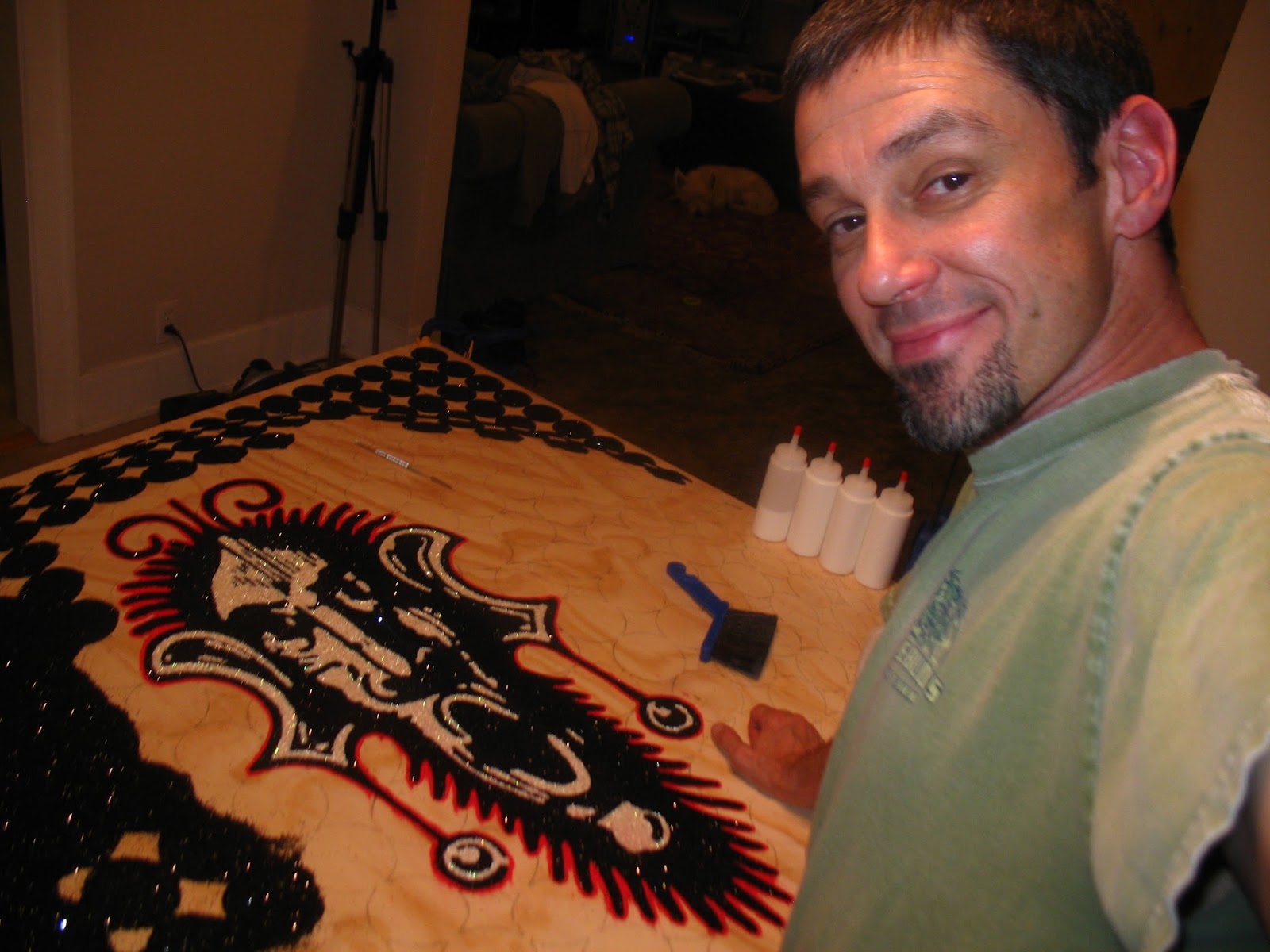 I’ve always known Sean
to be a deep thinker, a philosopher of sorts, constantly pondering life’s
biggest questions and mysteries. I was really blow away by one of his pieces
featuring Jimmy Hendrix and I decided to chat a bit with him to find out a bit more
about his creative process.
 Have you always been the creative artsy type?


 The flower of life/sacred geometry is actuality in the blue prints of everything we can see, feel, and touch. The flower of life contains Metatrons cube, which also precisely contains all the 5 platonic solids which make up everything in the material world. At this point I feel I've stumbled on a huge piece of suppressed truth that was once only shared with monks, masons, secret societies, but was intentionally leaked to the